California is home to some of the nation’s premier higher education systems, yet many students, particularly those facing the greatest barriers, find these institutions unaffordable. A key factor is the cost of attendance (COA), which helps set the limit on the total aid a student can receive each year. Federal rules let financial aid administrators adjust a student’s COA on a case-by-case basis when actual expenses are higher, but students must know these adjustments exist and how to request them.
Join John Burton Advocates for Youth (JBAY) and panelists from California’s public colleges and universities for a statewide webinar on the first comprehensive examination of how the state’s higher education institutions administer COA adjustments. Drawing on a survey of 57 undergraduate-serving campuses, data from the California Student Aid Commission, and more than a dozen interviews with financial aid administrators, the research highlights promising practices for making COA adjustments.
The webinar will also explore how these practices align with Assembly Bill 2251, which takes effect in the 2027-28 academic year and sets new transparency and accessibility requirements for COA budgets and adjustments. Panelists will close with recommendations for future policy and practice.
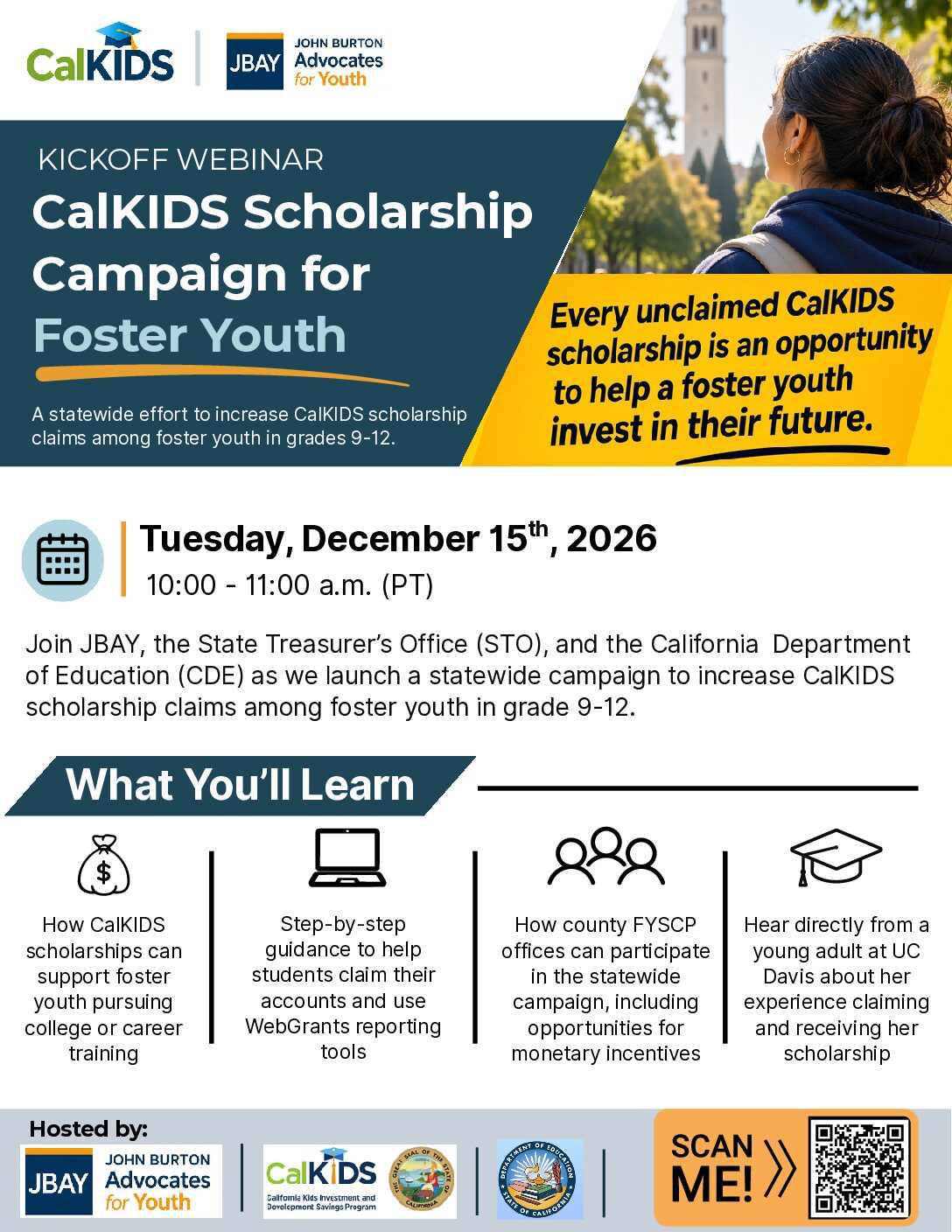
John Burton Advocates for Youth (JBAY), in partnership with the California State Treasurer’s Office (STO) and California Department of Education (CDE), is launching the CalKIDS Foster Youth Campaign, a statewide initiative exclusively for county Foster Youth Services Coordinating Programs (FYSCPs) to increase CalKIDS scholarship claims among foster youth in grades 9–12.
Building on the STO’s broader CalKIDS County Activation Campaign, this initiative emphasizes targeted outreach to foster youth, particularly following the recent eligibility expansion that opened scholarship opportunities to thousands more young people. With only 16% of eligible foster youth having claimed their scholarships, we’re inviting county Foster Youth Services Coordinating Programs (FYSCPs) to join us in working toward a statewide goal of 40% by May 2027!
County FYSCP staff will learn about CalKIDS eligibility, new WebGrants reporting tools, campaign participation requirements, and opportunities for monetary incentives.
The webinar will also feature a JBAY young adult advocate attending UC Davis, sharing her firsthand experience claiming and receiving her CalKIDS scholarship.
REGISTER HERE (for FYSCPs only)
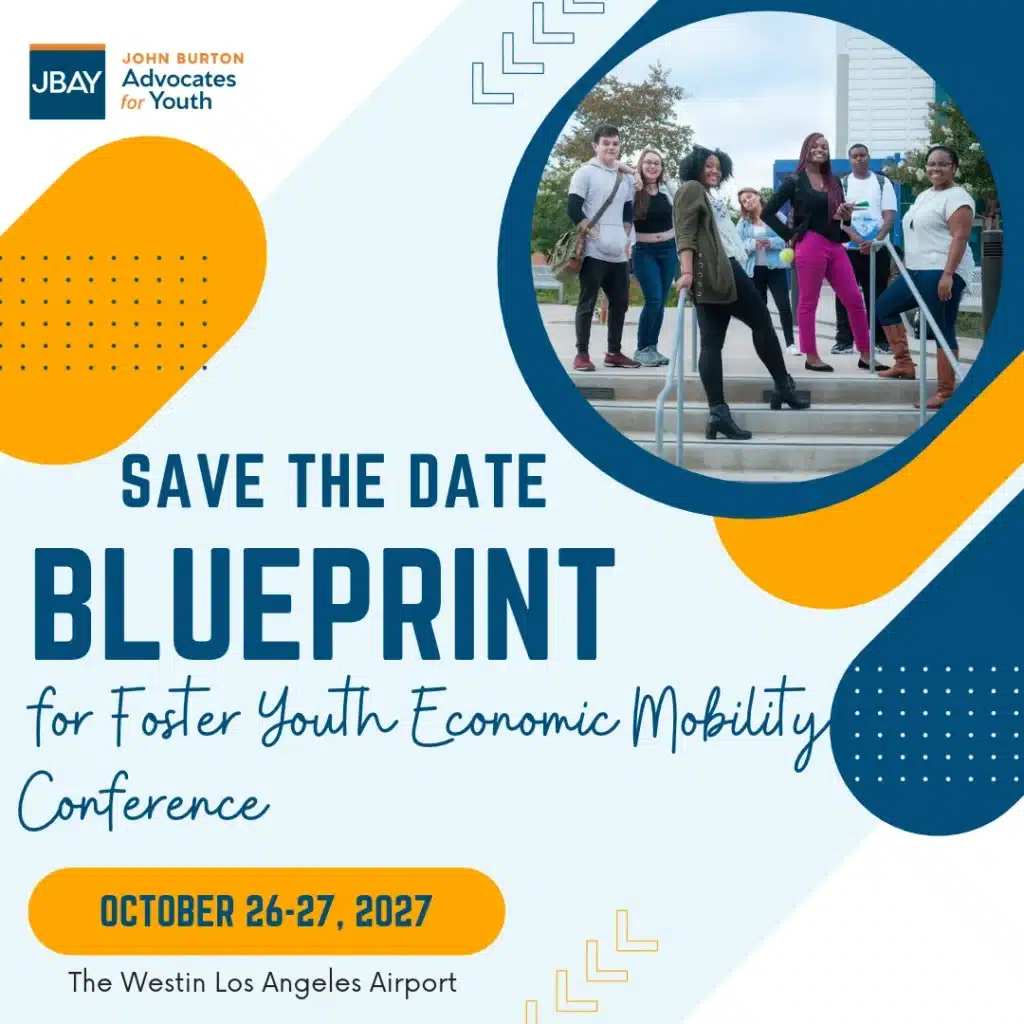
JBAY is thrilled to announce that its biennial Blueprint Conference will return October 26–27, 2027, at the Westin Los Angeles Airport, with an expanded focus on economic opportunity. This dynamic two-day event combines meaningful networking with in-depth, practical, solutions-oriented workshops aimed at helping students with experience in foster care achieve economic opportunity.
The conference will feature compelling plenary sessions, breakout workshops, and opportunities to strengthen connections across regions and systems, including a reception on the evening of October 26. Workshops will be presented by experts in education, employment, and housing, as well as by individuals with lived experience, all committed to helping foster youth build stable, self-sufficient futures.
The call for workshop proposals will be released in early spring 2027.
The American Rescue Plan and related federal pandemic legislation brought temporary changes in the tax laws that benefit transition-aged youth (18-24 year olds) with foster care experience and those experiencing homelessness. Young people who worked last year and parenting youth, for example, may be eligible for several thousand dollars. To get these funds young people must file their taxes. Come hear about the changes in the law that benefit young people, new resources you can use to spread the word, and how you can help them file their taxes this year.
Please join JBAY and California’s Reproductive Health Equity Project for Foster Youth (RHEP) for a webinar to learn about a new, virtual sexual education course designed specifically for foster youth in middle and high school.
Since 2017 when the California Foster Youth Sexual Health Education Act (SB 89) went into effect, child welfare agencies have struggled to connect youth to comprehensive sexual health education courses in the community when they miss this course in school. These challenges have been exacerbated by the COVID-19 pandemic, with limited in-person community education and support.
Teen Talk for Youth in Alternative Settings (Teen Talk YAS), designed by Health Connected is the newest SB 89-compliant curriculum designed for and informed by foster youth. Through collaboration with Planned Parenthood of Pasadena & San Gabriel Valley it has been adapted for virtual delivery and is now available.
Panelists will review the curriculum, how to sign up, and ways to support youth in attending and completing the course. Panelists include the curriculum development team, a health educator, a legal expert from the National Center for Youth Law, and a former foster youth who participated in developing and refining the online curriculum.
With the passing of AB 132, California has launched efforts to establish Basic Needs Centers across its 116 community college campuses by June of 2022. Basic Needs Centers are designed to encompass services to address food security, housing, mental health, safety, and other fundamental needs. Incorporating trauma informed principles into basic needs work is a critical part of helping students feel heard and supported.
The first part of this webinar will feature practical strategies on how to integrate a trauma informed approach to food security, as applied by Leah’s Pantry, a leading voice for trauma-informed nutrition education. This portion of the webinar will also feature a facilitated conversation by Adrienne Markworth, Executive Director of Leah’s Pantry, and practitioners from Mount San Antonio College and San Diego City College to explore how trauma informed strategies have been integrated into the basic need’s framework on each campus.
The second portion of the webinar will explore how basic needs work informs larger campus conversations around equity and access including topics like staff training, instructional design, and financial aid policies.
This webinar discusses strategies to help transition-age youth access the Earned Income Tax Credit (EITC) and the California Earned Income Tax Credit (CalEITC). For the 2022 tax season, the EITC is expanded to include foster youth age 18 and homeless youth age 19 and older. In 2019-20, the CalEITC was expanded from $400 million to $1 billion. This followed the expansion of eligibility to include transition-age youth without dependents, means many transition-age youth now qualify for the CalEITC. Webinar presenters include the California Franchise Tax Board, Santa Clara County Social Services Agency, and Law Foundation of Silicon Valley.