California is home to some of the nation’s premier higher education systems, yet many students, particularly those facing the greatest barriers, find these institutions unaffordable. A key factor is the cost of attendance (COA), which helps set the limit on the total aid a student can receive each year. Federal rules let financial aid administrators adjust a student’s COA on a case-by-case basis when actual expenses are higher, but students must know these adjustments exist and how to request them.
Join John Burton Advocates for Youth (JBAY) and panelists from California’s public colleges and universities for a statewide webinar on the first comprehensive examination of how the state’s higher education institutions administer COA adjustments. Drawing on a survey of 57 undergraduate-serving campuses, data from the California Student Aid Commission, and more than a dozen interviews with financial aid administrators, the research highlights promising practices for making COA adjustments.
The webinar will also explore how these practices align with Assembly Bill 2251, which takes effect in the 2027-28 academic year and sets new transparency and accessibility requirements for COA budgets and adjustments. Panelists will close with recommendations for future policy and practice.
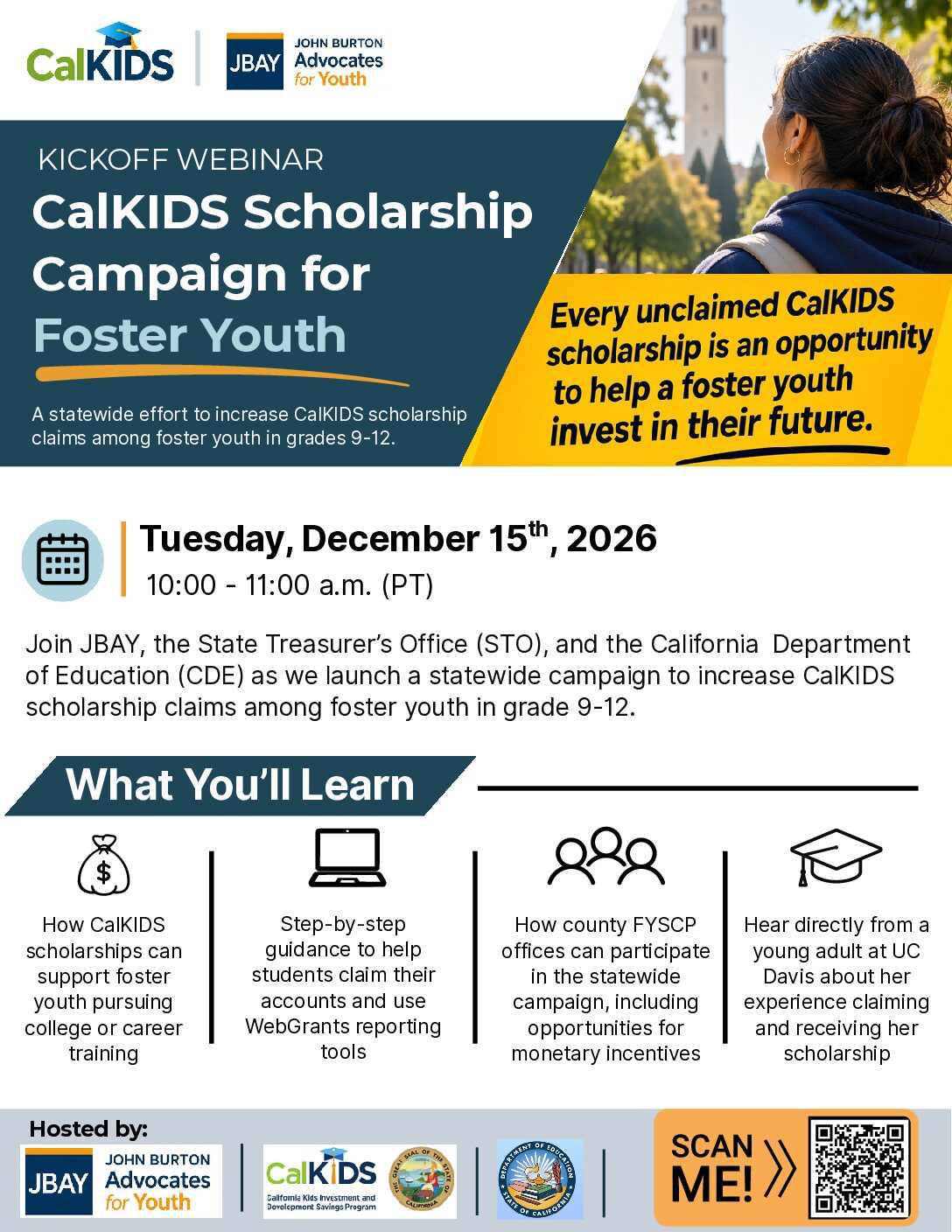
John Burton Advocates for Youth (JBAY), in partnership with the California State Treasurer’s Office (STO) and California Department of Education (CDE), is launching the CalKIDS Foster Youth Campaign, a statewide initiative exclusively for county Foster Youth Services Coordinating Programs (FYSCPs) to increase CalKIDS scholarship claims among foster youth in grades 9–12.
Building on the STO’s broader CalKIDS County Activation Campaign, this initiative emphasizes targeted outreach to foster youth, particularly following the recent eligibility expansion that opened scholarship opportunities to thousands more young people. With only 16% of eligible foster youth having claimed their scholarships, we’re inviting county Foster Youth Services Coordinating Programs (FYSCPs) to join us in working toward a statewide goal of 40% by May 2027!
County FYSCP staff will learn about CalKIDS eligibility, new WebGrants reporting tools, campaign participation requirements, and opportunities for monetary incentives.
The webinar will also feature a JBAY young adult advocate attending UC Davis, sharing her firsthand experience claiming and receiving her CalKIDS scholarship.
REGISTER HERE (for FYSCPs only)
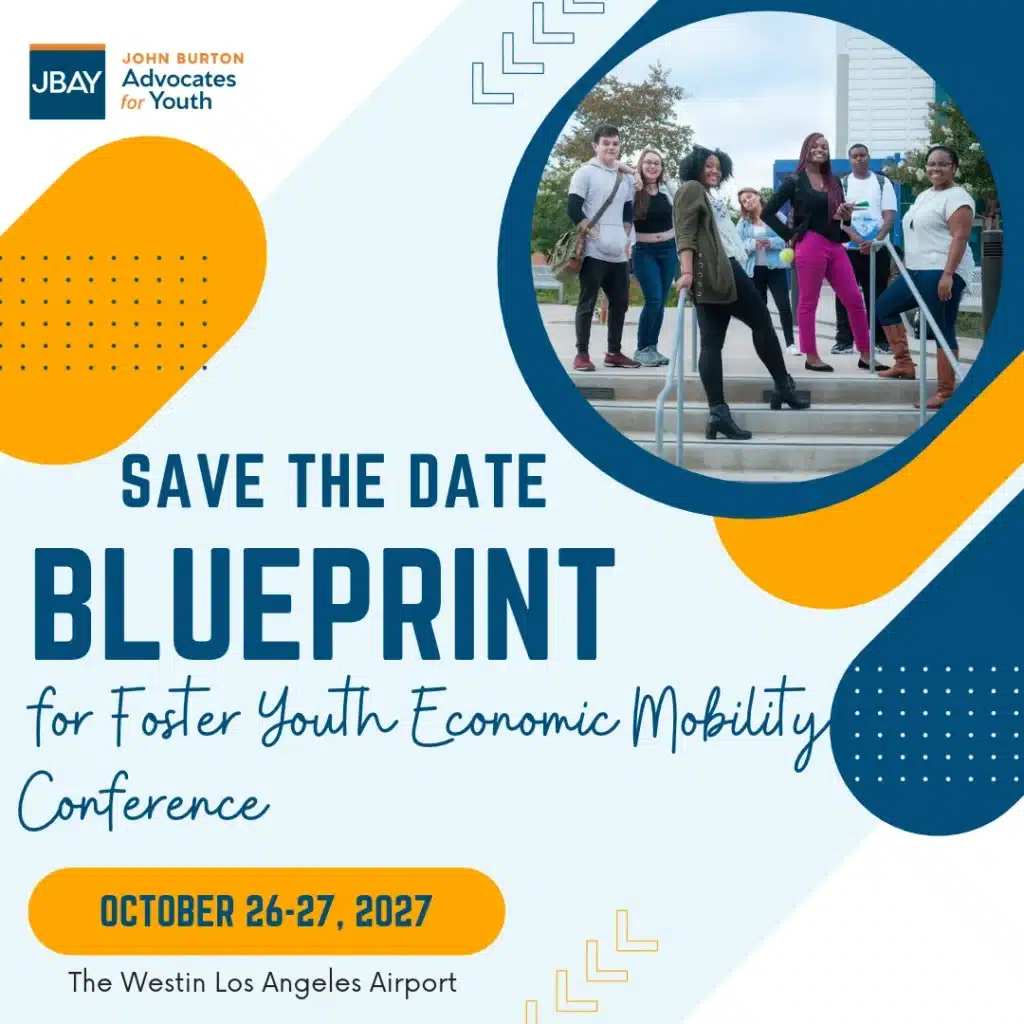
JBAY is thrilled to announce that its biennial Blueprint Conference will return October 26–27, 2027, at the Westin Los Angeles Airport, with an expanded focus on economic opportunity. This dynamic two-day event combines meaningful networking with in-depth, practical, solutions-oriented workshops aimed at helping students with experience in foster care achieve economic opportunity.
The conference will feature compelling plenary sessions, breakout workshops, and opportunities to strengthen connections across regions and systems, including a reception on the evening of October 26. Workshops will be presented by experts in education, employment, and housing, as well as by individuals with lived experience, all committed to helping foster youth build stable, self-sufficient futures.
The call for workshop proposals will be released in early spring 2027.
This event is intended to acknowledge and celebrate current and former foster youth in LA County who have earned an Associate’s degree, Bachelor’s degree, or have completed a certificate program during the 2025-26 academic year.
In addition to celebrating their success, we will be offering a buffet luncheon and ceremony where graduates will receive an award and a special gift in recognition of their incredible accomplishments.
Please register by May 15, 2026.
Join JBAY, the California Student Aid Commission (CSAC), and the State Treasurer’s Office (STO) for a statewide webinar on the recent expansion of the CalKIDS Scholarship for foster youth. Learn how this time-limited opportunity provides up to $1,500 for eligible students in grades 1–12, how to identify eligible youth using WebGrants reports, and how to support students in claiming their accounts. Participants will leave with practical tools and strategies to support outreach and help foster youth take an early step toward college and career success.
Please join John Burton Advocates for Youth for a web seminar and release of a new toolkit for county child welfare agencies, probation departments, and their partners, providing strategies for increasing the number of current and former foster youth who receive the California Foster Youth Tax Credit (FYTC). In 2026, the FYTC will provide up to $1,189 to young adults ages 18-25 who file their state taxes, were in foster care on or after age 13, and earned at least $1 in the tax year.
The toolkit will assist counties with implementing SB 624, which requires county child welfare and probation to mail annual information to all nonminor dependents on the FYTC and accessing free tax filing assistance. While the first mailing is not required until November 2026, JBAY is helping early adopters get their mailers out now, as well as advising on a series of other strategies to reach youth and connect them with free filing assistance.
Calling all current and former foster youth and the champions who support them! Join us for an inspiring introduction to the John Burton Fellowship, the first formal fellowship designed to place individuals with lived experience in foster care within the California Legislature and Executive Branch.
Developed in partnership between John Burton Advocates for Youth (JBAY) and the Center for California Studies at Sacramento State, this groundbreaking initiative expands the state’s prestigious Capital Fellows Programs, long recognized as one of the nation’s most respected public policy fellowships.
During this engaging panel, current and former Capital Fellows will share their personal journeys and insights from working at the highest levels of state government—drafting legislation, supporting executive agencies, and advancing equity across California. You’ll hear how this new fellowship opens doors for foster youth to bring their lived experience and leadership directly into the spaces where decisions are made.
Whether you’re a foster youth exploring your next step in education or public service, or a caring adult who supports them—such as campus staff, mentors, or nonprofit partners —this session will equip you with the information and inspiration to take action.
Attendees will learn about the application process, eligibility requirements, and how to prepare a strong submission for the 2025–2026 fellowship cycle (applications close December 8, 2025, at 11:59 p.m. PST). Don’t miss this chance to be part of history and help build a future where foster youth lead from the Capitol itself.