California is home to some of the nation’s premier higher education systems, yet many students, particularly those facing the greatest barriers, find these institutions unaffordable. A key factor is the cost of attendance (COA), which helps set the limit on the total aid a student can receive each year. Federal rules let financial aid administrators adjust a student’s COA on a case-by-case basis when actual expenses are higher, but students must know these adjustments exist and how to request them.
Join John Burton Advocates for Youth (JBAY) and panelists from California’s public colleges and universities for a statewide webinar on the first comprehensive examination of how the state’s higher education institutions administer COA adjustments. Drawing on a survey of 57 undergraduate-serving campuses, data from the California Student Aid Commission, and more than a dozen interviews with financial aid administrators, the research highlights promising practices for making COA adjustments.
The webinar will also explore how these practices align with Assembly Bill 2251, which takes effect in the 2027-28 academic year and sets new transparency and accessibility requirements for COA budgets and adjustments. Panelists will close with recommendations for future policy and practice.
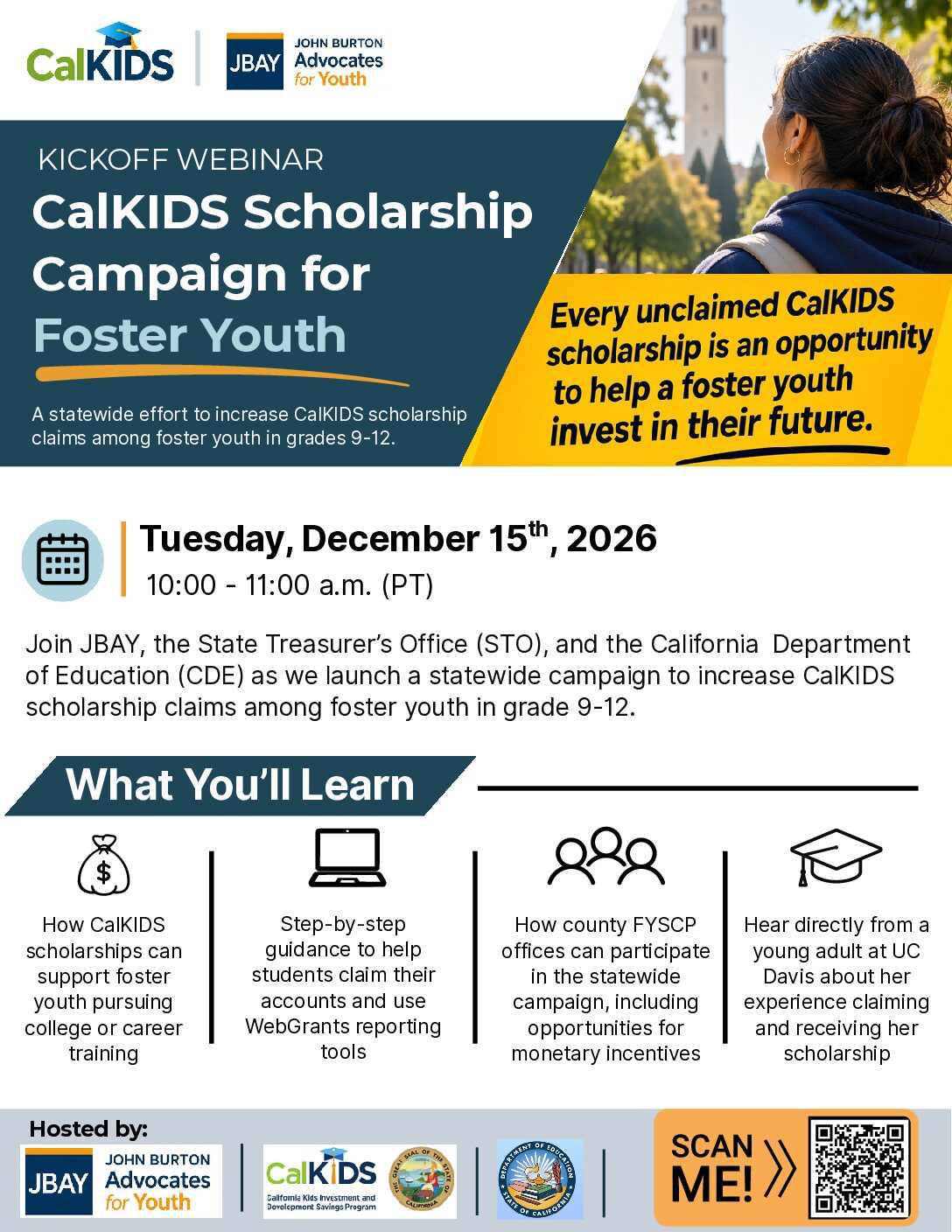
John Burton Advocates for Youth (JBAY), in partnership with the California State Treasurer’s Office (STO) and California Department of Education (CDE), is launching the CalKIDS Foster Youth Campaign, a statewide initiative exclusively for county Foster Youth Services Coordinating Programs (FYSCPs) to increase CalKIDS scholarship claims among foster youth in grades 9–12.
Building on the STO’s broader CalKIDS County Activation Campaign, this initiative emphasizes targeted outreach to foster youth, particularly following the recent eligibility expansion that opened scholarship opportunities to thousands more young people. With only 16% of eligible foster youth having claimed their scholarships, we’re inviting county Foster Youth Services Coordinating Programs (FYSCPs) to join us in working toward a statewide goal of 40% by May 2027!
County FYSCP staff will learn about CalKIDS eligibility, new WebGrants reporting tools, campaign participation requirements, and opportunities for monetary incentives.
The webinar will also feature a JBAY young adult advocate attending UC Davis, sharing her firsthand experience claiming and receiving her CalKIDS scholarship.
REGISTER HERE (for FYSCPs only)
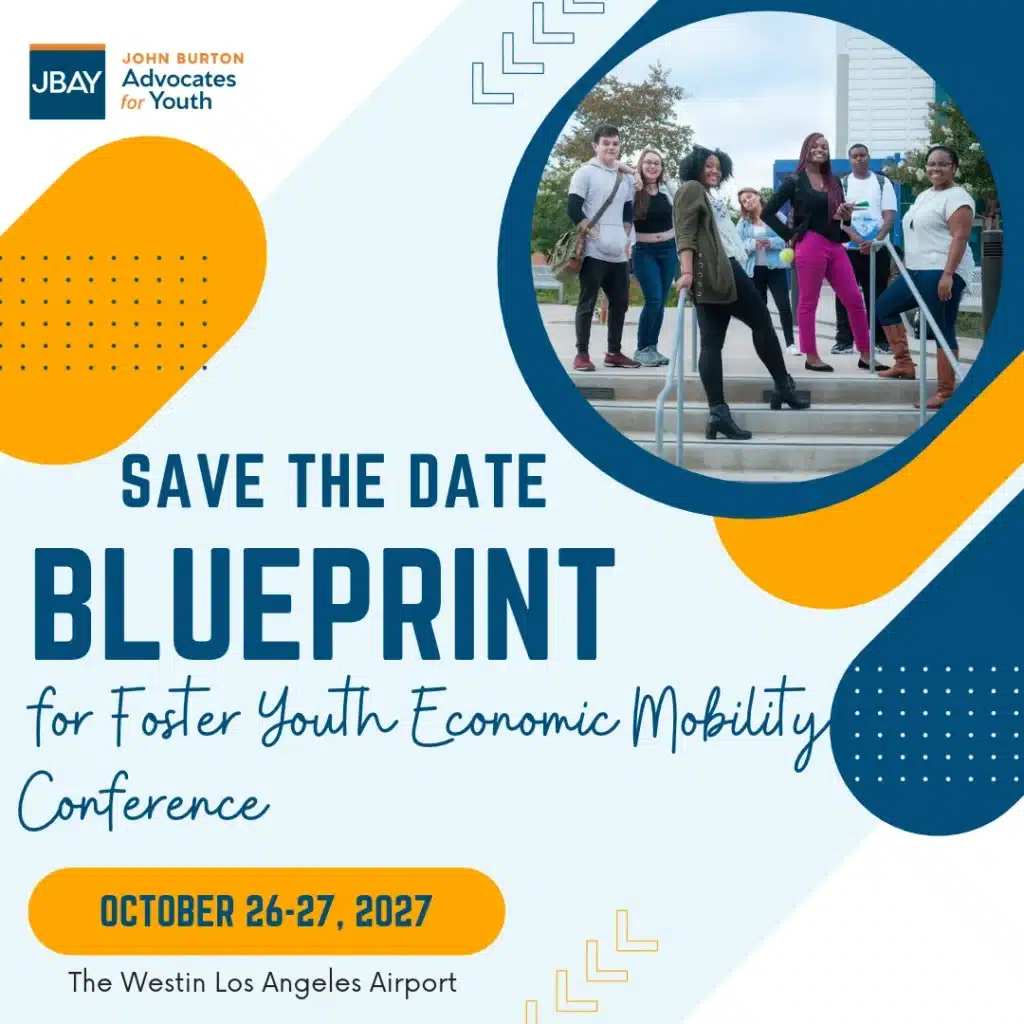
JBAY is thrilled to announce that its biennial Blueprint Conference will return October 26–27, 2027, at the Westin Los Angeles Airport, with an expanded focus on economic opportunity. This dynamic two-day event combines meaningful networking with in-depth, practical, solutions-oriented workshops aimed at helping students with experience in foster care achieve economic opportunity.
The conference will feature compelling plenary sessions, breakout workshops, and opportunities to strengthen connections across regions and systems, including a reception on the evening of October 26. Workshops will be presented by experts in education, employment, and housing, as well as by individuals with lived experience, all committed to helping foster youth build stable, self-sufficient futures.
The call for workshop proposals will be released in early spring 2027.
Please join John Burton Advocates for Youth for a webinar sharing findings and recommendations related to the reproductive and sexual health of foster youth residing in Short-Term Residential Therapeutic Programs (STRTPs), a congregate care placement established in 2016. Over the course of a 15-month learning community led by JBAY as part of the Los Angeles Reproductive Health Equity Project, 13 STRTPs collectively serving 539 youth across seven counties worked to improve their capacity to comply with legal requirements set forth in the California Foster Youth Sexual Health Education Act (SB 89, 2017), Community Care Licensing Standards, and best practice.
The webinar will confront the challenges of upholding some reproductive and sexual health rights of foster youth in a therapeutic setting designed to provide a high level of supervision and ensure safety: How can we allow youth to keep their own birth control when other medication must be locked up? How can we maintain continuity of care when a youth enters and exits the STRTP? What resources can staff use to help teach youth about puberty, sex, and healthy relationships? What LGBTQI friendly services are available in our community? Participating STRTPs will share the policy and practice changes they established during the learning community to address these challenges and best serve the young people in their care. Recommendations for STRTPs, counties, and the state will be offered.
2021 marks a decade since the extension of foster care to age 21 in California. The recently signed state budget for 2021-2022 also commits critical new funds to this population across housing, education and other service supports. In addition, Chapin Hall has just released a new CalYOUTH report on the effect of extended foster care two years after youth exit extended care, at age 23. And while research demonstrates positive outcomes for youth well-being through extended foster care measures, the data also reveal that there is much further to go in realizing the ultimate vision of extended care: to prepare transition age foster youth for life-long self-sufficiency and independence.
Over those ten years, First Place for Youth has become one of the largest providers of transitional housing and extended foster care services for foster youth in the state. And as an organization dedicated to data-informed service delivery and policy advocacy, First Place for Youth marked the 10-year anniversary by cultivating evidence-building partnerships to better understand “what really works” and releasing a research brief about the findings entitled Raising the Bar: Building system- and provider-level evidence to drive equitable education and employment outcomes for youth in extended foster care.
This Webinar will discuss key findings of that brief with implications for practice and policy reform. Jane Schroeder, Chief Policy Officer for First Place for Youth, will join an esteemed panel of experts to discuss how foster care organizations can leverage data and evidence to help inform policy recommendations and service interventions to better serve foster youth when they turn 18
Webinar will feature:
Mark Courtney, Samuel Deutsch Professor, University of Chicago
Amy Lemley, Executive Director, JBAY
Erika Van Buren, Chief Innovation Officer, FPFY
Jane Schroeder, Chief Policy Officer, FPFY